Story Highlights
- Elon Musk, Tim Cook, Larry Fink, and 13 other top CEOs are joining Trump on his state visit to China
- China is expected to announce purchases of Boeing aircraft, American agriculture, and energy
- Iran, tariffs, Taiwan, and rare earth minerals are also on the summit agenda
What Happened
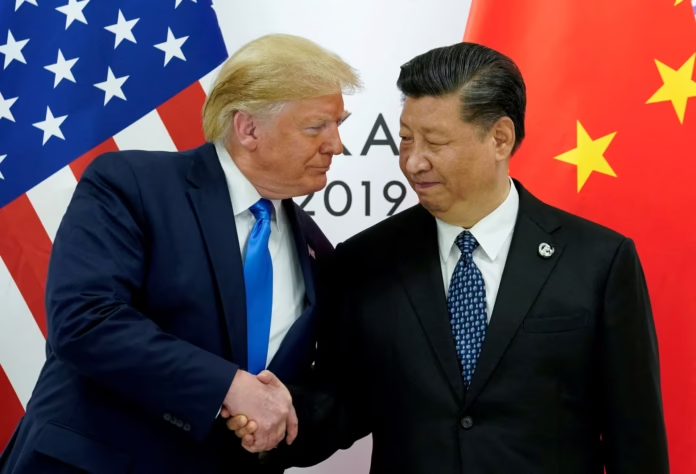
President Donald Trump departed for Beijing on Tuesday, traveling with an unprecedented corporate delegation that reflects his administration’s strategy of blending high-level diplomacy with direct business deal-making. According to a White House official, the list of executives accompanying Trump includes Tesla CEO Elon Musk, Apple CEO Tim Cook, BlackRock CEO Larry Fink, and Boeing CEO Kelly Ortberg, among many others. Also attending are Blackstone’s Stephen Schwarzman, Goldman Sachs CEO David Solomon, Citigroup CEO Jane Fraser, Mastercard CEO Michael Miebach, Qualcomm CEO Cristiano Amon, Visa CEO Ryan McInerney, GE Aerospace CEO H. Lawrence Culp Jr., and executives from Micron, Meta, Cargill, Coherent, and Illumina.
The trip was originally planned for April but was postponed due to the outbreak of the U.S.-Iran war in late February. The summit is scheduled over two days at the invitation of President Xi Jinping, with Trump also expected to visit the Temple of Heaven and attend a state banquet. Chinese foreign ministry confirmed on May 11 that the visit would run from May 13 to 15. Treasury Secretary Scott Bessent traveled ahead of the delegation to hold advance discussions with Chinese intermediaries.
The summit agenda is expected to cover trade tariffs, artificial intelligence, export controls, Taiwan, rare earth minerals, and the Iran war. China is widely expected to announce significant purchases of American goods — specifically Boeing aircraft, agricultural products, and energy — as a goodwill gesture to ease bilateral tensions. The U.S. and China are also expected to agree on the creation of new forums to facilitate mutual trade and investment, a signal of longer-term economic engagement even amid ongoing strategic competition.
The presence of top technology and financial executives signals that the private sector is deeply invested in the outcome of these talks. Since Trump’s first visit to Beijing more than eight years ago, U.S.-China merchandise trade has fallen by more than one-third. The partial commercial deal Trump signed with Chinese leaders during his first term failed to deliver on its advance billing, and both governments are acutely aware of the risks of another round of diplomatic theater without substance.
On the Iran dimension, Trump is expected to press Xi to use China’s considerable economic leverage over Tehran to help reopen the Strait of Hormuz and push Iran toward accepting a nuclear deal. China is by far Iran’s largest oil customer, accounting for roughly 80 to 90 percent of Iranian oil exports before the war. The Trump administration has been aggressively sanctioning Chinese companies and individuals who facilitate those purchases, most recently targeting 12 entities under the “Operation Economic Fury” campaign — a move timed deliberately just before the summit.
Why It Matters
The Beijing summit is arguably the most consequential bilateral meeting of Trump’s second term. At a moment when the global economy is being roiled by the Iran war, the relationship between Washington and Beijing carries outsized importance for markets, policymakers, and ordinary Americans alike. A constructive summit could reduce energy market uncertainty, unlock Chinese pressure on Iran, and open pathways for increased U.S. exports that would benefit a range of American industries.
For the American business community, represented in the delegation by some of the nation’s largest employers, the stakes are enormous. Companies like Apple, Boeing, and Qualcomm have significant exposure to Chinese supply chains and markets. A thaw in trade relations — including potential reductions in tariffs, which have been a persistent irritant — could materially improve the outlook for these firms and the workers they employ. Boeing in particular stands to benefit from Chinese aircraft purchase commitments that would support American manufacturing jobs.
The inclusion of Elon Musk in the delegation is particularly noteworthy. Tesla operates a major manufacturing facility in Shanghai and has significant business interests in China. Musk’s presence alongside government officials sends a signal that technology and electric vehicles will be on the discussion agenda, even if that agenda is not publicly detailed. His dual role as a business executive and a figure closely associated with Trump’s administration adds a layer of complexity to how the Chinese side will interpret the delegation’s composition.
For Republicans, a successful summit that produces visible economic wins — announced purchases, new trade frameworks, lower energy prices — would provide much-needed positive news heading into a midterm election season dominated by economic anxiety. The administration is keenly aware that its approval ratings on economic issues have fallen sharply, and a diplomatic triumph in Beijing would give it a concrete achievement to tout.
Economic and Global Context
The economic backdrop for the summit could hardly be more fraught. Brent crude oil remains above $113 per barrel, having surged roughly 65 percent since the war with Iran began on February 28. The Strait of Hormuz, which normally carries approximately 20 percent of the world’s seaborne oil trade, has been effectively blocked since then, chocking off 10 to 12 million barrels of daily crude supply from global markets. The World Bank projects average Brent prices of $86 per barrel for the full year, with scenarios as high as $115 depending on the conflict’s trajectory.
The rare earth minerals issue is another critical dimension of the summit. China controls a dominant share of global rare earth production and processing, and it imposed export restrictions in 2025 that exposed significant U.S. national security vulnerabilities. The U.S. has responded with billions in domestic financing and global partnerships, but analysts acknowledge the country remains far from self-sufficient. A deal on rare earths — even a partial one — would ease pressure on American defense manufacturers and technology companies that depend on these materials.
U.S.-China trade relations have been strained since Trump’s first term, when a series of tariffs were imposed on hundreds of billions of dollars in Chinese goods. While some tariffs were subsequently modified, the broader trade architecture remains contentious. Analysts at the Heritage Foundation and the Center for Strategic and International Studies have cautioned that expectations for breakthroughs should be modest — the real measure of success may simply be leaving Beijing without triggering a new crisis.
Implications
If the summit produces a visible package of Chinese purchase commitments — especially in Boeing aircraft and American energy — it will generate positive economic headlines that the Trump administration will aggressively promote. A China-announced commitment to pressure Iran, even indirectly through reduced oil purchases, would be seen as a major diplomatic victory and could alleviate some of the pressure on ceasefire talks. Such an outcome would provide the administration with political ammunition as it navigates a challenging domestic environment.
However, analysts warn that durable structural changes in the U.S.-China relationship are unlikely from a single summit. China’s strategic interests — in Taiwan, in maintaining its relationship with Iran, and in preserving its economic advantages — are not aligned with American preferences, and Xi is unlikely to make significant concessions without receiving meaningful ones in return. The Heritage Foundation specifically warned that China may make tactical concessions on negotiable items while holding firm on its core strategic priorities.
For American voters and consumers, the most tangible near-term outcome would be any movement on energy prices. If the summit produces credible progress toward reopening the Strait of Hormuz, oil markets could respond quickly, providing relief at the pump that would benefit both ordinary Americans and Republican candidates in November. Without such progress, the economic headwinds facing the GOP will continue to intensify through the summer and into the fall campaign season.

