Story Highlights
- Sen. Bill Cassidy finished third in Louisiana’s Republican Senate primary, failing to advance to the June 27 runoff
- Trump-backed Rep. Julia Letlow and State Treasurer John Fleming will face each other in next month’s runoff
- Cassidy is the first GOP senator to lose renomination in a primary in close to ten years
What Happened
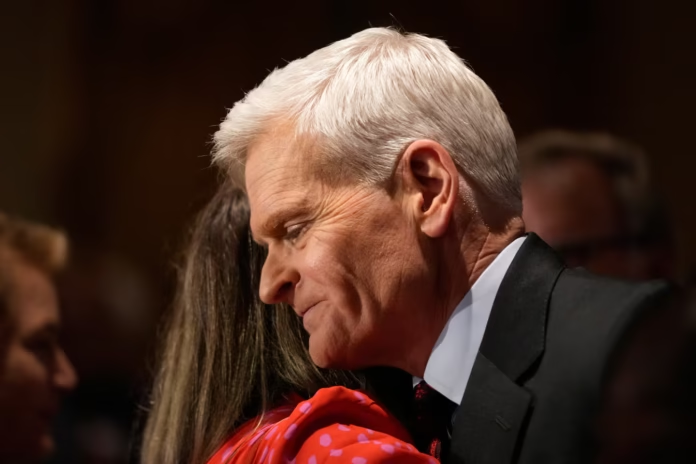
Senator Bill Cassidy, a two-term Louisiana Republican and physician, was eliminated from his reelection bid Saturday after finishing third in the state’s Republican Senate primary behind Trump-backed Representative Julia Letlow and State Treasurer John Fleming. Letlow coasted to an easy first-place finish but fell short of the 50 percent threshold needed to avoid a runoff, setting up a June 27 contest between her and Fleming for the nomination. The winner of that runoff will be the heavy favorite in ruby-red Louisiana this November.
Trump had targeted Cassidy relentlessly over the senator’s vote to convict him during the second impeachment trial following the January 6, 2021, Capitol riot — one of only seven Republican senators to do so. After Cassidy’s defeat was confirmed, Trump posted on Truth Social: “His disloyalty to the man who got him elected is now a part of legend, and it’s nice to see that his political career is OVER!” Trump had earlier recruited Letlow specifically for the race and reiterated his endorsement on primary day.
The race unfolded under newly changed rules. Louisiana had historically held a “jungle primary” open to all voters regardless of party, which would have allowed Cassidy to draw Democratic and independent support. This year, Trump ally and Governor Jeff Landry architected a shift to a semi-closed primary system, effectively limiting participation to Republican voters and removing the crossover buffer that Cassidy might otherwise have used to survive.
In his concession speech, Cassidy pointedly declined to mention Trump by name but made his meaning clear. “Our country is not about one individual,” he told supporters. “When you participate in democracy, you don’t pout, you don’t whine, you don’t claim the election was stolen.” It was among the most direct public rebukes of Trump delivered by a sitting Republican senator in years.
Cassidy was not the only Republican Trump was targeting this week. The primary of Representative Thomas Massie of Kentucky, a Trump critic who had pushed for the release of the Epstein files, was scheduled for Tuesday, May 19. Cassidy’s removal has intensified pressure on Massie and anyone else in the party considering a break with the president.
Why It Matters
The elimination of Cassidy is not merely a single electoral result — it is a data point that will shape the behavior of every Republican in Congress for the remainder of Trump’s term and beyond. Of the seven GOP senators who voted to convict Trump in 2021, four chose to retire rather than face a primary. Cassidy ran anyway and lost. Senator Susan Collins of Maine faces her own reelection this year, though she is not currently facing a primary challenge; even Trump’s allies acknowledge she is the party’s best option for holding that seat.
The message to Republican legislators is stark: policy disagreements can be managed, but a direct vote against Trump on a question of personal political survival is treated as an unforgivable offense. This dynamic has implications for ongoing votes in the Senate, including debates over the One Big Beautiful Bill Act and nominations that Trump considers personal priorities.
Cassidy’s defeat also underscores the role that structural changes — such as closed primaries — play in reinforcing Trump’s dominance within the party. In a more open election, the outcome might have been different. The deliberate shift to a closed format by a Trump-aligned governor is a template other red states could consider adopting for future cycles.
From a policy standpoint, Cassidy’s loss removes a credentialed voice in health care policy from the Senate. As chairman of the Senate Health, Education, Labor and Pensions Committee, he had been a vocal and informed critic of Health and Human Services Secretary Robert F. Kennedy Jr. on vaccine policy. His exit clears the path for a more uniformly MAGA-aligned Senate caucus.
Economic and Global Context
The political realignment underway within the Republican Party has tangible downstream effects on legislative output and economic policymaking. A Senate increasingly homogenous in its loyalty to Trump is less likely to push back on trade policies, fiscal measures, or executive actions that might otherwise attract dissent from independent-minded Republicans.
The Louisiana Senate race was also financially consequential. Cassidy held a significant campaign finance advantage for most of the contest. That his money advantage proved insufficient against the power of a Trump endorsement tells donors and political operatives something important about where influence actually resides in the current GOP environment.
Nationally, political analysts will be watching the Cassidy outcome as a gauge of Trump’s overall midterm strategy. With Republicans holding narrow majorities in both chambers, the president’s ability to shape the primary landscape — and therefore the ideological composition of the caucus he will work with in his final two years — is a form of pre-legislative power that has no real historical parallel.
Polling consistently shows that Trump’s approval in national surveys is weaker than his approval among Republican primary voters. The Cassidy result is a reminder that primary elections, not general elections, are the arena where Trump currently wields the most direct power — and where he is deploying it with precision.
Implications
The immediate next test is the Kentucky primary involving Representative Thomas Massie on May 19. Massie’s conflict with Trump arose from his advocacy for the release of the Epstein files, a politically charged issue with its own coalition of supporters and detractors within the conservative movement. A Massie defeat would confirm that Cassidy’s loss was part of a broader pattern, not an isolated case.
The Letlow-Fleming runoff on June 27 will offer its own data point. With Trump having endorsed Letlow, the runoff becomes a test of whether the presidential endorsement remains decisive even in head-to-head contests between two Trump-aligned candidates — and what that says about the relative influence of grassroots conservative organizing versus top-down presidential support.
For Senate Democrats, Cassidy’s exit removes a potential partner on bipartisan legislation. He had worked across the aisle on infrastructure and pandemic preparedness. His loss makes it harder to assemble the kind of cross-party coalitions that have occasionally passed significant legislation even in polarized Congresses.
For the Republican Party as an institution, the question looming over the Cassidy result is what happens after Trump. The candidate infrastructure, media operation, and grass-roots loyalty Trump has built are formidable, but they are personal. Whether they translate into durable party infrastructure — or whether the party faces a fractious post-Trump identity crisis — will be one of the defining questions of the next political era.
Sources
“Louisiana senator who voted to convict Trump loses Republican primary”

