Story Highlights
- Trump said in his NBC “Meet the Press” interview that while he wants Fed Chair Kevin Warsh to be independent, he views a rate hike as the wrong decision
- Markets had already begun pricing in rate hike probability after a blowout May jobs report, with futures traders assigning roughly 61% odds of higher rates by year-end
- Warsh, sworn in on May 22, faces his first FOMC meeting next month and has publicly said he will not set policy based on Trump’s preferences
What Happened
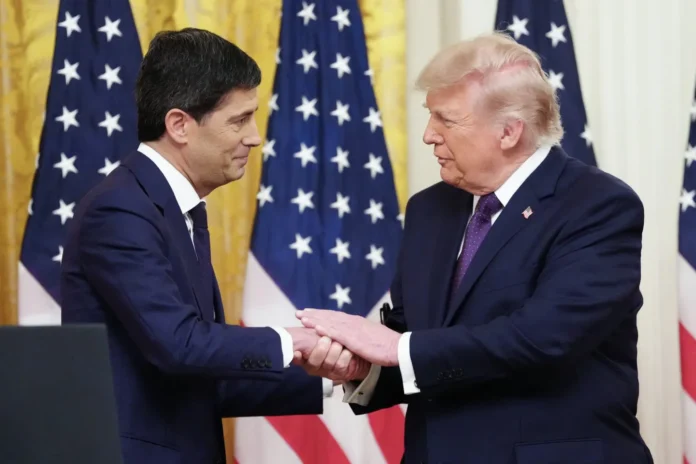
During his taped interview with NBC’s “Meet the Press,” President Donald Trump addressed the future direction of Federal Reserve monetary policy directly — and in terms that leave little doubt about his preferences. Trump praised newly confirmed Fed Chair Kevin Warsh, calling him fantastic, and said he wants Warsh to have full independence in setting policy. He added, pointedly, that he did not want to exert heavy influence over the Fed Chair’s decisions. In the same breath, however, Trump said a rate increase would be wrong, framing his remark as pushback against growing market expectations that stronger-than-expected economic data is making rate cuts impossible and hikes more likely.
The comments came against a specific economic backdrop. On the Friday before the interview aired, the Bureau of Labor Statistics released a May jobs report that significantly exceeded analyst expectations. Strong employment data traditionally signals inflationary risk, and bond markets responded accordingly — Treasury yields across multiple durations spiked, with 30-year yields rising above 5 percent and shorter-term 2-year Treasuries hitting their highest levels of the year. Futures traders recalibrated their projections, moving from expectations of rate cuts to a growing consensus that the first major policy action under Warsh could be a hike rather than a reduction.
Warsh, 56, was sworn in on May 22 after a lengthy confirmation process and succeeds Jerome Powell, who served eight years as Fed Chair and remains on the Fed’s Board of Governors. At his swearing-in ceremony, Trump told the new chair to be “totally independent” and not to look to him for guidance. Yet at a campaign-style rally later that same evening, Trump told the crowd that interest rates would come down “very quickly” — a contradiction that financial analysts noted immediately and that continues to define the ambiguity of the relationship between the White House and the central bank under the new leadership arrangement.
Warsh has been publicly consistent in maintaining that he will not set policy based on the president’s views. He has acknowledged some openness to rate cuts in previous public commentary but is known from his prior stint as a Fed Board member between 2006 and 2011 for favoring tighter monetary policy. At his first FOMC meeting scheduled for next month, he will also have to navigate the unusual presence of his predecessor Powell, who remains on the board in a governor capacity — a historically unprecedented configuration.
Why It Matters
The tension between Trump’s publicly stated preferences and the economic data environment Warsh must navigate is not merely an academic monetary policy debate. Interest rate decisions by the Federal Reserve have direct, measurable effects on the cost of mortgages, business loans, auto financing, credit card debt, and the broad investment climate that determines hiring and economic growth. When a president publicly signals opposition to rate hikes in an environment where economic data is pointing toward them, it creates a form of institutional pressure that complicates the Fed’s ability to communicate its independence credibly to markets.
That credibility matters enormously. The Federal Reserve’s effectiveness as an inflation-fighting institution rests substantially on its perceived independence from short-term political preferences. If market participants believe that the Fed Chair is susceptible to presidential pressure, their own inflation expectations will adjust accordingly — potentially worsening the very inflation dynamics that make rate hikes necessary. Trump’s interview comments, while framed as supportive of Warsh’s independence, landed in markets as a clear statement of presidential preference that some analysts interpreted as influence rather than endorsement.
For American households, the rate direction has immediate practical consequences. Mortgage rates remain elevated relative to pre-pandemic levels, and a rate hike would push them higher still. Credit card rates and home equity line costs would also rise. Conversely, delay in addressing inflationary pressures through appropriate rate adjustments has its own costs in eroded purchasing power over time.
Economic and Global Context
The macroeconomic picture that Warsh inherits is genuinely complicated. Inflation has remained above the Fed’s two percent target for five consecutive years, a streak that spans the latter part of the Biden administration through the first 17 months of Trump’s second term. The May jobs report — with its upside surprises in both job creation and wage growth — reflects an economy that, in the labor market dimension at least, remains robust despite elevated interest rates and the disruptive impact of the Iran war on energy prices.
Treasury yield dynamics are particularly telling. The spike in 30-year yields above 5 percent reflects long-term investor anxiety about inflation persistence and fiscal deficits rather than just near-term rate expectations. When yields rise across both short and long durations simultaneously, it suggests a market view that tightening conditions are necessary at multiple time horizons — a signal that runs directly counter to Trump’s preference for rapid rate reduction.
The Iran war’s impact on oil prices adds another complicating variable. Elevated energy costs filter through to broader consumer price indices and complicate the Fed’s ability to make the clean argument that inflation is cooling toward target levels. If the ceasefire framework holds and the Strait of Hormuz reopens on schedule, energy prices could moderate — which would give Warsh more room to consider rate stability or eventual cuts. A fresh escalation, conversely, would worsen the inflationary picture significantly.
Implications
Warsh’s first FOMC meeting next month will be one of the most closely watched in years. Markets will be listening not only for the rate decision itself but for every word of the accompanying statement and press conference — parsing the new chair’s language for signals about the pace and direction of future adjustments, and for any indication of how he plans to manage the relationship between his stated independence and the administration’s known preferences.
For Trump, the outcome carries midterm implications. He has staked a significant portion of his economic narrative on the promise that rates will come down, making credit more affordable and stimulating growth. If Warsh’s first major action is a hold or a hike, that narrative faces a serious challenge heading into November.
For financial markets more broadly, the coming weeks represent a period of elevated uncertainty across equities, bonds, and currency markets. Investors are recalibrating expectations simultaneously across several interrelated variables — inflation data, Fed direction, presidential pressure, Iran war resolution, and fiscal trajectory — in a combination that portfolio managers describe as unusually complex.
Sources
“Trump Says Fed Rate Increase Would Be Wrong Ahead of Warsh Debut”

