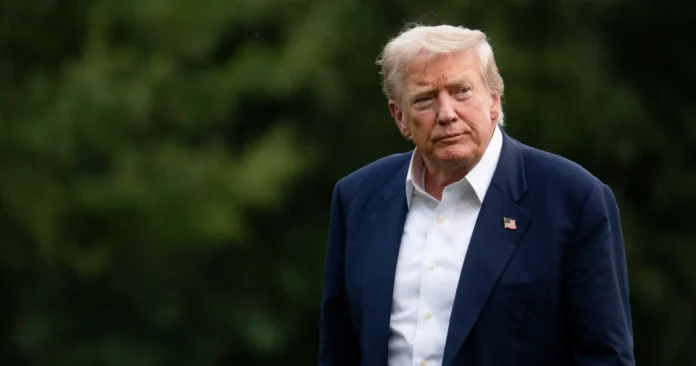
President Donald Trump’s job approval rating has sunk to the lowest point of his second term, with multiple major polls released this week documenting a broad and deepening erosion of public confidence. A new Pew Research Center survey placed his approval at 34 percent, while the Silver Bulletin polling average recorded a net approval of negative 18.9 points as of May 8, 2026. The numbers are alarming for a president whose party faces a challenging midterm environment in November and whose political operation is simultaneously demanding loyalty from Republicans across the country.
Story Highlights
- A Pew Research Center survey conducted April 20–26 found Trump’s approval rating at 34 percent, the lowest mark of his second term.
- The Silver Bulletin polling average placed Trump’s net approval at negative 18.9 on May 8, with roughly 48 percent of Americans strongly disapproving of his performance.
- Approval among Trump’s 2024 Hispanic voters has fallen 27 points since early 2025, compared to a 14-point drop among White Trump voters in the same period.
What Happened
A major Pew Research Center survey released this week painted a detailed and troubling picture of President Donald Trump’s standing with the American public. Conducted from April 20 through April 26 with 5,103 U.S. adults, the poll found his overall job approval at 34 percent, a figure that represents the lowest point of his second term. Public disapproval has risen 13 points since he took office, moving from 44 percent to 57 percent, as discontent has spread across a range of personal attributes and policy areas.
One of the most striking findings in the Pew survey involved perceptions of Trump’s honesty. Only 38 percent of Americans now say the description “keeps his promises” applies to the president, down from 43 percent last August and from 51 percent in the weeks following his reelection in November 2024. The erosion of trust on this attribute is particularly significant given that Trump’s political brand has long rested on the idea that he delivers on his commitments where conventional politicians fail.
The decline in Trump’s standing has not been confined to Democrats and independents. Among Republicans and Republican-leaning independents, approval of Trump’s job performance has fallen from 73 percent in January to 68 percent in the most recent survey. The share of Republicans who say Trump “keeps his promises” has dropped six percentage points from last year and 14 points from November 2024. Confidence in Trump’s handling of military force among Republicans has fallen 11 points since last year, with GOP confidence on foreign policy overall declining by seven points over the same period.
A separate Washington Post-ABC News-Ipsos poll released May 3 documented similar trends, finding that Americans are broadly dissatisfied with Trump’s leadership on the Iran war and other key economic issues. The poll also found that Democratic voters are significantly more motivated to vote in November than their Republican counterparts, a voter enthusiasm gap that could prove decisive in close House races.
Why It Matters
Presidential approval ratings are among the most reliable predictors of midterm election outcomes. The historical average for the incumbent president’s party in midterm elections is a loss of approximately 28 House seats. With Trump’s approval now in the mid-30s, well below the 40-percent threshold that historically marks the boundary between bad and catastrophic midterm results, the political outlook for Republicans is serious.
The geographic and demographic composition of Trump’s declining support compounds the electoral risk. The 27-point drop in approval among Hispanic voters who supported Trump in 2024 is particularly striking, since Hispanic voters helped provide critical margins in several key swing states and congressional districts that delivered Republican majorities. A significant deterioration of that support threatens Republican competitiveness in districts across Florida, Texas, Arizona, and Nevada.
A majority of Americans, 56 percent according to Pew, now say the overall level of ethics and honesty in the federal government has fallen during Trump’s tenure. Only 19 percent say it has risen. This finding is significant because it suggests that public concern about Trump is not limited to specific policy disagreements but extends to a broader assessment of governmental integrity. That kind of generalized dissatisfaction tends to produce large-scale electoral punishment rather than targeted losses in specific policy-sensitive districts.
The Democratic enthusiasm gap documented in multiple polls adds another layer of concern for Republicans. A Washington Post-ABC News poll found that 73 percent of Democrats described the upcoming midterm as more important than previous elections, a level of intensity comparable to the wave election years of 2006 and 2018. Republican enthusiasm, by contrast, has fallen from 65 percent calling themselves very enthusiastic about voting in 2018 to 53 percent today.
Economic and Global Context
The polling collapse is directly connected to economic frustrations that have built steadily since Trump’s second term began. Democrats now hold an advantage over Republicans on economic credibility for the first time since 2010, according to Brookings Institution analysis, a remarkable reversal for a party that has historically been at a disadvantage on economic management. The connection between the Iran war, energy prices, and household budgets has been a central driver of this shift.
Gasoline prices averaging $4.30 per gallon nationally are among the most visceral economic stressors for American households. Unlike stock market fluctuations or abstract macroeconomic indicators, gas prices are experienced directly and repeatedly by nearly every working family in the country. The political salience of fuel costs has made the Iran war’s economic consequences impossible to insulate from domestic approval ratings.
The broader economic environment has also been shaped by Trump’s tariff policies, which have increased costs for a range of consumer goods. While the administration argues that tariffs are necessary to rebuild American manufacturing, the near-term effect has been upward price pressure on imported goods. Combined with energy cost increases tied to the Iran conflict, these price pressures have undermined the economic confidence that helped propel Trump to victory in 2024.
Implications
The persistence of Trump’s low approval ratings through the spring of 2026 suggests that the political damage is structural rather than temporary. A sustained approval rating in the low-to-mid 30s heading into a midterm election is historically associated with major seat losses. Brookings analysis indicates that Democrats could pick up enough seats to win a House majority under current conditions, with Democratic gains in Ohio, North Carolina, Maine, and Alaska among the most likely flips.
For Republican incumbents, the polling data creates a nearly impossible political situation. Distancing from the president risks triggering a primary challenge from the MAGA base, as the Indiana results demonstrated this week. Remaining aligned with an unpopular president, however, exposes them to general election vulnerability with the moderate voters who decide competitive districts. There is no easy path forward for Republicans caught between these competing pressures.

