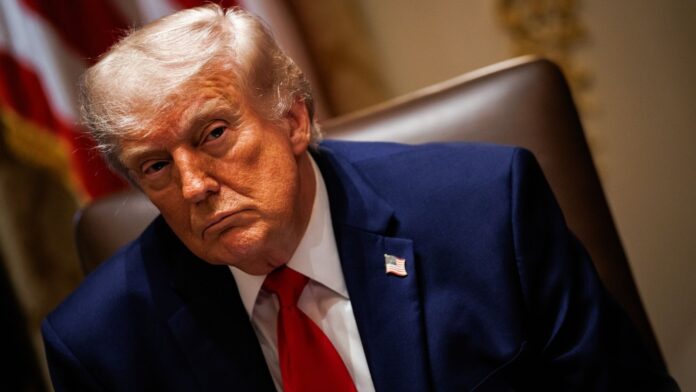
The United States and Iran traded military strikes overnight Wednesday into Thursday, escalating tensions even as diplomatic talks to formally end the three-month-old war reportedly edge toward a preliminary framework. President Donald Trump, speaking at a Cabinet meeting Wednesday, vowed he would not accept a substandard peace agreement and rejected an Iranian state media report that he might agree to allow Iran and Oman to jointly manage the Strait of Hormuz. The renewed military exchanges underscore how fragile the April ceasefire remains — and how far the two sides are from a durable resolution.
Story Highlights
- Iran’s Islamic Revolutionary Guard Corps confirmed it struck an unspecified U.S. air base, saying the attack was retaliation for American strikes near Bandar Abbas Airport in southern Iran.
- American and Iranian negotiators are believed to have drafted a preliminary agreement to extend the ceasefire and gradually reopen the Strait of Hormuz, but neither Trump nor Iran’s Supreme Leader Mojtaba Khamenei has approved it.
- Trump rejected any arrangement in which Iran and Oman jointly control Strait of Hormuz traffic, stating the waterway “is going to be open to everybody.”
What Happened
The United States and Iran exchanged fresh military strikes overnight Wednesday into Thursday, the latest in a series of hostile actions that have continued on both sides despite a nominal ceasefire declared in April. Iran’s Islamic Revolutionary Guard Corps stated it targeted an unspecified American air base, saying the operation was a direct response to U.S. strikes conducted near Bandar Abbas Airport in southern Iran. The IRGC did not identify which American installation was targeted or provide casualty figures.
The strikes occurred just hours after President Donald Trump appeared at a Cabinet meeting at the White House and declared that peace negotiations with Iran were progressing. During the session, Trump was challenged by ABC News correspondent Rachel Scott about a report from Iranian state television suggesting the administration might accept a deal allowing Iran and Oman to jointly manage traffic through the Strait of Hormuz. Trump flatly rejected the premise: “The strait is going to be open to everybody.” He described his overall negotiating posture as refusing to accept what he called a “crummy agreement.”
The current conflict began on February 28, 2026, when the United States and Israel launched massive coordinated strikes targeting Iranian military, governmental, and infrastructure sites. Trump announced at the time that major combat operations had commenced. Iran retaliated by striking U.S. military bases and energy infrastructure in Saudi Arabia and the United Arab Emirates — the first time the conflict directly affected American Gulf allies. Thousands of Iranians were estimated killed in the initial offensive.
A ceasefire was brokered in April following initial talks held in Pakistan, which failed to produce a peace agreement. Trump subsequently announced an open-ended extension of the ceasefire alongside continuation of a U.S. naval blockade until negotiations concluded. American forces have nonetheless continued conducting what U.S. Central Command has described as “self-defense” strikes on Iranian missile launch sites and vessels placing mines, even while the administration publicly characterized talks as moving forward.
According to reporting by ABC News, American and Iranian negotiators believe they have assembled a draft agreement that would formally extend the ceasefire and chart a gradual path to reopening the Strait of Hormuz. However, both Trump and Iran’s Supreme Leader Mojtaba Khamenei — who assumed the position following the death of Ali Khamenei — have not yet given the draft their approval. Secretary of State Marco Rubio returned from diplomatic engagements in South Asia this week, and Trump has additionally demanded that any comprehensive peace deal require multiple countries, including Saudi Arabia and Pakistan, to join the Abraham Accords as a condition of settlement — a demand that significantly complicates the diplomatic calculus.
Why It Matters
The U.S.-Iran conflict is the most consequential military engagement of Trump’s second term, and its outcome will define his foreign policy legacy. The war has already produced thousands of casualties, disrupted global energy markets, damaged infrastructure in multiple countries, and tested the cohesion of America’s Gulf alliances. Whether Trump can convert his “maximum pressure” approach into a durable diplomatic win will shape not only his historical standing but also the immediate political environment heading into the 2026 midterms.
The Strait of Hormuz occupies the geographic center of these negotiations for strategic and economic reasons that are impossible to overstate. Roughly 20 percent of the world’s daily oil supply — approximately 17 to 21 million barrels — transits through the narrow passage under normal conditions. Any sustained restriction of that flow drives up global energy prices, increases inflation across multiple economies, and imposes direct costs on American consumers at gas stations and in household budgets.
Trump’s rejection of joint Iranian-Omani management of the strait reflects his foundational negotiating posture: maximum leverage, maximal terms. The approach has produced results in some contexts — Trump points to the Abraham Accords of his first term and early tariff negotiations in his second as evidence. But the Iran conflict involves a sovereign state fighting for its institutional survival, and that dynamic creates limits to how much pressure can be applied before negotiating partners abandon talks entirely.
The linkage of the Iran ceasefire to broader Abraham Accords expansion adds another complicating variable. Asking Iran — or even Saudi Arabia, whose participation in the Accords would be an enormous diplomatic prize — to normalize relations with Israel as part of a war-ending agreement effectively merges two of the most intractable diplomatic problems in the region into a single negotiation. That ambition may prove too expansive to be workable on the timeline that the current military situation demands.
Economic and Global Context
The Iran conflict’s effect on global energy markets has been significant and sustained. Crude oil prices surged following the February strikes, with Brent crude briefly exceeding $95 per barrel before retreating somewhat as ceasefire news emerged in April. Energy market analysts have maintained that uncertainty around Strait of Hormuz access keeps a substantial geopolitical risk premium embedded in crude prices — a premium that flows directly into gasoline prices, transportation costs, and manufactured goods across the American economy.
Gulf state allies, including Saudi Arabia and the UAE, absorbed direct economic damage from Iranian retaliatory strikes on their energy infrastructure following the initial American offensive. Both countries host U.S. military installations and have been essential to American regional strategy for decades. Their continued willingness to serve as forward-operating platforms for American forces depends on Washington delivering a credible diplomatic resolution that reduces their exposure to future Iranian strikes.
China and India — the world’s two largest crude oil importers — have been monitoring the conflict with acute concern. Any prolonged closure or sustained restriction of Strait of Hormuz transit would require both countries to seek more expensive alternative supply routes or accept reduced imports, with direct consequences for their industrial output and economic growth projections. European energy markets, still carrying elevated sensitivity from years of Russian supply disruption, have also been affected by the Iran conflict’s spillover effects on global oil pricing.
Implications
If Trump successfully negotiates a ceasefire agreement that secures permanent, unrestricted access to the Strait of Hormuz — on terms that do not require concessions perceived as weakness — he would claim a major foreign policy achievement that his campaign’s “strength through maximum pressure” doctrine promised. That outcome would likely improve his approval ratings, bolster Republican midterm prospects, and partially counteract the domestic political damage his administration has incurred over the past several months.
The risks of failure, however, are equally consequential. A stalled negotiation, an escalation beyond the current containable level, or a catastrophic strike on a Gulf ally’s infrastructure would convert the Iran war from a potential asset into a defining liability. No president in the modern era has survived the political fallout of a prolonged and inconclusive military engagement with public approval already under significant pressure.
For Iranian leadership, the existence of a drafted preliminary agreement is itself a significant signal. The willingness to produce that document reflects a practical assessment that continued conflict imposes unsustainable costs. How Khamenei — new to the supreme leadership role and navigating both domestic hardliners and international pressure — handles the final stages of negotiation will determine whether a deal is reached or whether the fragile ceasefire collapses entirely.
Source
U.S. military strikes Iran as Trump says negotiations move forward for deal to end war

