Story Highlights
- U.S. and Iranian delegations agreed on a roadmap for a final deal within 60 days, with technical working groups continuing their work
- Vice President JD Vance led the American team alongside envoys Steve Witkoff and Jared Kushner; Iran was led by parliamentary Speaker Mohammad Bagher Ghalibaf
- Iran’s delegation briefly walked out after Trump posted threats of further military strikes during the live negotiations
What Happened
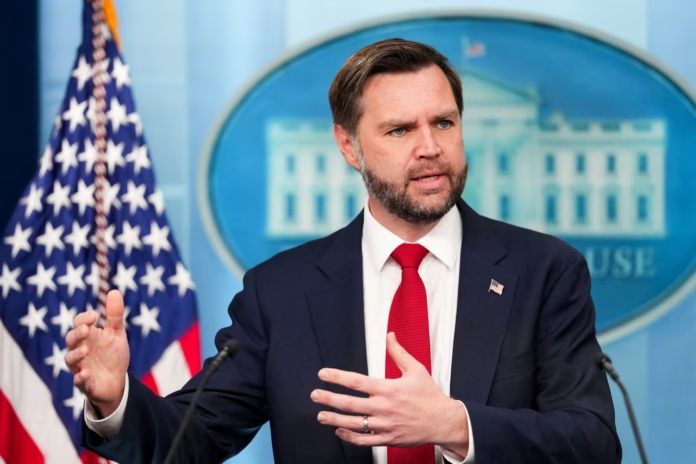
Vice President JD Vance arrived in Switzerland in the early morning hours of Sunday, June 21, leading the American delegation for the first round of high-level talks with Iran. Flanked by special envoys Steve Witkoff and Jared Kushner, Vance sat across from Iran’s lead negotiator, parliamentary Speaker Mohammad Bagher Ghalibaf, at the luxury Burgenstock resort complex, with mediators Pakistan and Qatar also present.
The talks began on rocky footing. While Vance was seated at the negotiating table, President Trump posted on social media threatening to strike Iran “very hard again, just like we did last week, only harder” over continued fighting in Lebanon by Iran-backed Hezbollah. Iran’s delegation briefly walked out in response. Ghalibaf warned publicly that Iran’s armed forces were ready to respond to threats, and the talks appeared on the verge of collapse before proceeding through the night.
By Monday, the session concluded with a significant joint statement from mediators Pakistan and Qatar. The parties had agreed on a roadmap toward reaching a final deal within 60 days, established communication lines to keep the Strait of Hormuz open, and created a deconfliction cell involving Lebanon to prevent further escalation between Israel and Hezbollah. Technical working groups covering nuclear issues, sanctions, and a monitoring and dispute resolution mechanism were also formed.
Despite the tense atmospherics, Vance struck an optimistic tone publicly, telling reporters the United States had already made great progress and expressing hope for a fundamental transformation of the American relationship with Iran. He also said the U.S. had done more to stop the conflict in Lebanon than any other government in the world.
Why It Matters
The Switzerland talks represent the highest-stakes diplomatic engagement of Trump’s second term on the Iran front. The conflict began after Israeli and U.S. air strikes on Tehran on February 28, and has since cost significant American lives, resources, and economic stability. A ceasefire has nominally been in effect since April 8, and the June 17 Memorandum of Understanding between Trump and Iranian President Masoud Pezeshkian established the 60-day framework now being implemented through the working groups.
The fact that both sides agreed to a roadmap despite the turbulent start is a meaningful diplomatic development. The roadmap includes specific mechanisms — working groups on nuclear issues and sanctions, a deconfliction cell for Lebanon, and communication channels for the Strait of Hormuz — that represent substantive progress beyond vague promises of continued talks.
For the Trump administration, the Switzerland outcome is a critical part of its foreign policy legacy claim. The president has repeatedly asserted that he would achieve what previous administrations could not: a durable settlement with Iran on nuclear and regional issues. Delivering that outcome before the midterms would represent an enormous political asset heading into November.
Iran’s nuclear posture remains a central unresolved issue. Iranian President Pezeshkian publicly reiterated during the talks that Tehran would not give up its right to enrich uranium, though Iran continues to deny seeking nuclear weapons. That position will be the crux of the final negotiations between the two sides.
Economic and Global Context
Energy markets responded immediately to signals from the Switzerland talks. Oil prices, which had spiked to $81.66 per barrel for Brent crude when Trump threatened military action over the Strait of Hormuz, began easing as the Burgenstock sessions produced positive signals. The Strait handles roughly 20 percent of global oil trade, and any sustained disruption to shipping in the waterway carries direct inflationary consequences across Western economies.
Analysts at UBS noted that while the roadmap agreement represents an important breakthrough, it is the beginning rather than the end of a process to address Iran’s nuclear capabilities and end the war. Market confidence in a durable resolution remains cautious, and energy traders have priced in continued uncertainty through at least the end of the 60-day negotiating period.
Global allies are also tracking the negotiations carefully. European partners who depend on Middle Eastern energy imports have strong economic incentives to see the conflict resolved. Israel’s ongoing operations in Lebanon remain a destabilizing variable, with Israeli Prime Minister Benjamin Netanyahu publicly stating that Israeli troops would remain in southern Lebanon as long as necessary — a position that directly complicates the deconfliction architecture established in Switzerland.
Implications
The 60-day timeline is both an opportunity and a constraint. Final deal terms must address Iran’s nuclear program, sanctions relief, Lebanon, and regional security arrangements — an enormously complex package. Both sides enter the technical phase with significant domestic political pressures. Trump faces a skeptical Congress and midterm headwinds. Iran’s government faces its own internal debate about how far to go in accommodating American demands.
For American businesses and consumers, a successful deal could deliver sustained relief on energy prices and reduce the inflationary pressure that has burdened households throughout the conflict. A deal that includes meaningful Iranian nuclear concessions would also represent a significant national security achievement, strengthening the case for Trump’s approach of military pressure followed by negotiation.
If the talks collapse, the consequences could be severe. Trump has indicated the U.S. military is ready and that he could resume strikes. A return to active hostilities would spike oil prices, rattle financial markets, and further complicate an already difficult midterm environment for Republicans holding narrow congressional majorities.
Sources
“US, Iran agree on ‘roadmap’ towards final deal in Switzerland talks”

