Story Highlights
- Vance warned states that fail to prosecute Medicaid fraud could lose billions in federal funding for anti-fraud units
- The Centers for Medicare and Medicaid Services announced the deferral of $163 million to California due to non-compliance
- The anti-fraud task force, established by Trump in March, has already suspended 221 hospice and healthcare providers in California
What Happened
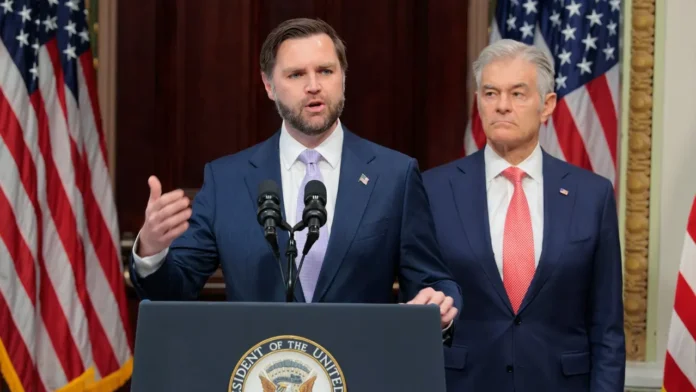
Vice President JD Vance warned Wednesday that states could lose federal funding if they fail to aggressively pursue Medicaid fraud, escalating the Trump administration’s pressure campaign on governors and state Medicaid officials. “We are sending letters that will require them to show that they are effectively and aggressively prosecuting Medicaid fraud in their states. And if they do not, if they do not aggressively prosecute Medicaid fraud, we are going to turn off the money that goes to these anti-fraud units,” said Vance during a press conference.
Vance said the federal government has provided states with “billions of dollars” for Medicaid Fraud Control Units. He continued that if states do not take the fraud crackdown seriously, other resources within their Medicaid programs could be shut off as well.
Vance was joined at the event by U.S. Attorney Andrew Ferguson, CMS Director Dr. Oz, and Kim Brandt. CMS also announced the deferral of $163 million due to non-compliance by California.
President Trump announced a “War on Fraud” during his State of the Union address in February and named Vance as the head of a new task force to carry it out. The vice president has led the task force to find and bust fraud across multiple agencies since it was formalized in March.
Vance also announced new efforts to combat fraud in federal healthcare programs, specifically targeting California, whose Democratic governor is himself a 2028 presidential hopeful and a frequent sparring partner of the administration.
Why It Matters
The Medicaid program covers more than 80 million Americans and represents one of the largest items in the federal budget. Fraud within the system drains resources that are intended for low-income patients, elderly beneficiaries, and disabled Americans who rely on government-sponsored healthcare. By putting states on notice, the Trump administration is directly tying fiscal accountability to continued federal support — a significant shift in how Washington has traditionally managed the joint federal-state program.
Vance argued that dealing with fraud alone could prolong the Medicare and Medicaid trust funds well into the future, with a budgetary impact potentially reaching hundreds of billions of dollars or more. “We are not going to have a generous country if Americans think that they’re paying their taxes not to needy people, but to fraudsters,” he said. “That’s fundamentally what we’re trying to fix — rebuilding America’s trust.”
The political dimension of the crackdown is unmistakable. Vance compared himself to the kid in “Home Alone,” with both Trump and Secretary of State Marco Rubio traveling in China this week, giving the vice president an opportunity to command the White House stage and demonstrate his policy credentials ahead of a 2028 presidential race that remains unspoken but universally understood.
The confrontation with California also carries electoral stakes. Targeting the nation’s most populous Democratic state on healthcare spending resonates strongly with Republican base voters who view California’s governance as a symbol of progressive overreach. The $163 million deferral announcement was a tangible, immediate consequence designed to signal that the administration’s threats carry real weight.
Economic and Global Context
The federal government spends approximately $600 billion annually on Medicaid, a figure that has grown steadily over the past two decades. Estimates of fraud within the program vary widely, but government watchdogs and independent analysts have consistently found that improper payments — including outright fraud — account for tens of billions of dollars per year. The scale of the problem means that even modest improvements in enforcement can yield substantial fiscal dividends.
The task force has suspended hundreds of hospices suspected of fraud in Los Angeles alone since being established in March. Vance said the administration does not want to turn off any money but emphasized the goal is to ensure that people are “taking fraud seriously” and to protect both Medicare and Medicaid from being what he described as “fleeced by fraudsters.”
The broader economic context matters as well. With the federal deficit running at roughly $1.7 trillion over the past twelve months, according to Congressional Budget Office estimates, every dollar recovered from fraudulent healthcare claims directly reduces pressure on American taxpayers. The administration has argued that a more rigorous approach to Medicaid fraud compliance is consistent with its broader push to reduce government spending enacted through the One Big Beautiful Bill Act.
The move also arrives at a moment when states are navigating their own fiscal pressures. Many governors, both Republican and Democrat, have expanded Medicaid coverage in recent years, increasing federal and state spending. A threat to cut anti-fraud unit funding could paradoxically reduce the investigative capacity of the very agencies Washington is demanding perform better.
Implications
For state governments singled out by the administration, the pressure creates a difficult political calculation. Compliance with the federal anti-fraud mandate requires demonstrating tangible prosecutorial action, which takes time and resources that state Medicaid agencies may not have readily available. Democratic governors facing their own 2026 or 2028 ambitions are unlikely to capitulate publicly, setting up protracted legal and political battles over the funding conditions.
Vance, who chairs the administration’s anti-fraud task force, is already extending the campaign beyond press conferences. He is scheduled to visit Maine on Thursday to highlight the administration’s fraud-fighting efforts ahead of the state’s primary elections, making clear that the issue is being folded into the Republican midterm political strategy.
For healthcare providers, the escalating scrutiny means heightened compliance obligations and greater risk of audits, suspensions, and prosecutions. The hospice industry in California has already felt the pressure, with hundreds of providers suspended. Other sectors of Medicaid-funded care, including home health agencies and substance abuse treatment programs, should anticipate similar scrutiny.
Ultimately, the success of the anti-fraud campaign will be measured not by press conferences but by prosecutions, recovered funds, and demonstrable reductions in improper payments. The administration has set expectations high, and the gap between rhetoric and results will be closely watched by Congress, the states, and the American public as the midterm elections approach.
Sources
“Vance turns up heat on states with federal cash threat over Medicaid fraud crackdown”

