Story Highlights
- The White House ballroom project, which began as a $200 million privately funded initiative announced in July 2025, has grown to an estimated $400 million cost as Trump doubled the original estimate and expanded the venue’s planned capacity to seat 1,350 guests
- Senate Republicans proposed $1 billion in federal funding for “security adjustments and upgrades” related to the ballroom site; the White House says this covers only security elements, while critics argue the distinction is meaningless since security and construction are inseparable
- A federal judge has expressed skepticism about whether the administration has legal authority to proceed without congressional approval, and a lawsuit from the National Trust for Historic Preservation remains pending
What Happened
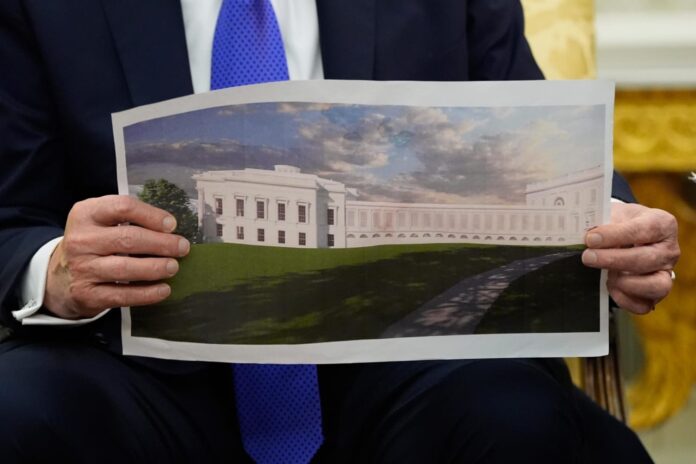
President Donald Trump announced plans for a new White House ballroom in July 2025, demolishing the historic East Wing — which had housed the offices of every first lady since Eleanor Roosevelt — to make way for a grand new event space. The president promised at the outset that the project would cost approximately $200 million and involve “not one dime of government money,” funded entirely by private donations from Trump himself and unnamed supporters.
The project has not unfolded according to that description. By September 2025, Trump announced the venue would seat 900 guests — a 40 percent increase from the original capacity. The lead architect, James McCrery, stepped down in December amid reported disagreements with the president over continued expansion of the project’s scale. By early 2026, Trump acknowledged the cost had doubled to $400 million. “We’re donating a $400 million ballroom and we got sued not to build it,” he said, predicting he would ultimately deliver it for less.
The project’s relationship with federal taxpayer funds became explicit in early May 2026 when Senate Republicans proposed $1 billion in funding for what they described as “security adjustments and upgrades” tied to the ballroom site. The Senate Judiciary Committee, led by Republican members, included the appropriation in legislation related to White House security. Senate Republicans maintained the funding covered only security elements — bulletproof glass, drone detection, chemical filtration systems, and other protective infrastructure — and not the ballroom itself.
Following a classified briefing by the Secret Service, senators remained divided. Reports indicated that only approximately $220 million of the $1 billion would be used for direct ballroom-related security fortification; the remainder would fund White House complex security more broadly. The White House insisted the characterization of the funds as ballroom financing was inaccurate, but the distinction proved insufficient to quiet Republican skeptics or Democratic critics.
U.S. District Court Judge Richard J. Leon has separately expressed skepticism about whether the administration had the legal authority to proceed with construction without explicit congressional approval. The National Trust for Historic Preservation filed a lawsuit seeking to halt construction, and while Judge Leon declined an immediate stop, he instructed the administration not to finalize plans pending his ruling. His decision and any appeal are expected to play out in the coming weeks.
Why It Matters
The ballroom controversy intersects with one of the most politically toxic dynamics facing Republicans heading into November: voter perception that the administration prioritizes personal prestige over economic relief. Trump’s approval rating on economic handling stands at roughly 37 percent in recent polling, with inflation and affordability driving widespread dissatisfaction. Against that backdrop, a $400 million construction project at the White House — partially financed through mechanisms critics characterize as taxpayer-funded — is difficult political terrain for Republican incumbents seeking to distance themselves from spending optics.
The original pledge of zero government funding was not incidental. It was a political commitment designed to pre-empt exactly the criticism that has materialized. The gap between that commitment and the $1 billion security appropriation proposed by Republican senators exposes a credibility problem that opponents of the administration will exploit repeatedly. Whether the funds technically qualify as direct ballroom financing matters less politically than the narrative that taxpayers are paying for a presidential monument.
For Senate Republicans navigating an already difficult relationship with the White House over the anti-weaponization fund and immigration enforcement spending, the ballroom dispute adds another source of friction. Several senators who remained skeptical after the Secret Service briefing must now decide whether to support the funding or break publicly with a request the White House clearly wants fulfilled.
Economic and Global Context
The $400 million ballroom project exists in a federal fiscal environment of significant stress. The national debt continues to grow, discretionary spending is under pressure, and the administration has simultaneously pursued substantial reductions in the federal workforce and social programs in the name of fiscal responsibility. The visual contrast between those cuts and a nine-figure presidential construction project has not escaped public notice, and polling consistently shows Americans viewing executive spending on the White House as a low priority.
The parallel Senator Lindsey Graham proposal to fund the ballroom directly with $400 million offset by customs fees raises additional questions about fiscal coherence. Using trade revenue — itself a tax on American consumers of imported goods — to fund a presidential entertainment venue is a framing that Democratic messaging operations have eagerly adopted in communications to voters in competitive districts.
The legal dispute also carries institutional implications. If courts determine that the administration exceeded its authority in proceeding with construction without congressional approval, it would establish an important precedent about the limits of executive unilateral action in altering the historic character of federal facilities.
Implications
For the White House, the path of least resistance is maintaining that the federal appropriation covers genuine security needs and that the ballroom remains privately financed. That framing will be tested repeatedly in the months ahead as construction progresses and the full cost picture becomes clearer. Any further cost increases — the project has already doubled from its initial estimate — will renew scrutiny and provide fresh ammunition to critics.
For Senate Republicans who must vote on the security appropriation, the decision carries campaign trail consequences. In competitive districts and states where voters are focused on kitchen-table economic concerns, a vote for $1 billion in White House-adjacent spending requires a defensible explanation. Republican candidates in swing seats are already being asked about it.
For the broader debate about executive accountability, the ballroom controversy reflects a recurring pattern in the Trump administration of announced commitments — on spending, on transparency, on process — that diverge from eventual execution. Whether courts, Congress, or voters provide the primary accountability mechanism for that divergence is a question the rest of 2026 will answer.
Sources

