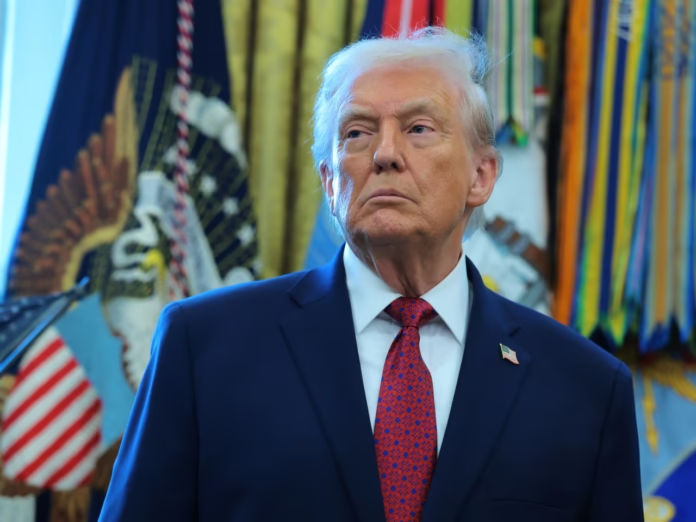
President Trump has refiled his $10 billion defamation lawsuit against the Wall Street Journal, its parent companies, and two of its reporters over a 2025 report tying him to a bawdy birthday letter allegedly sent to Jeffrey Epstein. The renewed filing comes after a federal judge dismissed Trump’s original lawsuit for failing to meet the legal standard required of public figures in defamation cases. The case represents one of the largest defamation actions ever filed by a sitting American president against a major news organization.
Story Highlights
- Trump refiled the $10 billion lawsuit against Dow Jones, News Corp, Rupert Murdoch, and two Wall Street Journal reporters in federal court in Florida
- The suit stems from a July 2025 Journal report describing a birthday letter allegedly bearing Trump’s name sent to Jeffrey Epstein in 2003
- A federal judge dismissed the original lawsuit in April, ruling Trump failed to adequately allege the paper acted with “actual malice”
What Happened
President Donald Trump filed an amended version of his defamation lawsuit against The Wall Street Journal in federal court in Florida, refiling the case after a judge dismissed his original complaint earlier this year. The lawsuit targets the Journal’s publisher Dow Jones, parent company News Corp, News Corp Chairman Emeritus Rupert Murdoch, News Corp CEO Robert Thomson, and two Journal reporters, seeking more than $10 billion in damages over a July 2025 article describing a purported birthday letter sent to disgraced financier Jeffrey Epstein in 2003.
The article at the center of the dispute reported that Trump had sent Epstein a letter for his 50th birthday featuring a sketched outline of a naked woman and a typed message signed with Trump’s name, concluding with the line referencing a shared secret between the two men. Trump has repeatedly and categorically denied writing or sending the letter, calling it fake. His original lawsuit, filed in July 2025 in Miami federal court, alleged the article was part of a “deliberate smear campaign” timed to inflict maximum political and reputational damage.
U.S. District Judge Darrin Gayles dismissed that original complaint in April, ruling that Trump had failed to sufficiently allege the paper acted with “actual malice,” the legal standard public figures must meet in defamation cases, requiring proof that a publisher either knew a statement was false or acted with reckless disregard for the truth. Notably, Gayles’s ruling did not address whether the underlying reporting about the letter was itself accurate, focusing instead narrowly on the legal sufficiency of Trump’s malice allegations. The dismissal gave Trump’s legal team an opportunity to refile an amended complaint addressing the deficiencies identified by the court.
The revised lawsuit, filed to meet a court-ordered deadline, seeks to bolster the malice allegations by claiming that the reporters, the Journal, Dow Jones, and Murdoch all published the story either knowing it was false or with reckless disregard for whether it was true. The Wall Street Journal has consistently stood behind its original reporting, with a Dow Jones spokeswoman stating the paper has “full confidence in the rigor and accuracy” of its journalism and would “vigorously defend against any lawsuit.” The paper has previously reported that its journalists personally reviewed the letter and accompanying drawing, which were part of a larger compiled birthday book gifted to Epstein by numerous associates and later reviewed by the Department of Justice during its investigation into Epstein.
Why It Matters
The renewed lawsuit represents a significant test of the actual malice standard that has long protected news organizations from defamation claims brought by public officials, a legal framework established by the Supreme Court’s landmark 1964 decision in New York Times v. Sullivan. Should Trump’s amended complaint survive a renewed motion to dismiss, the case could proceed toward discovery, potentially forcing the Journal to disclose internal newsroom communications and sourcing information related to one of the most politically sensitive stories published about the president.
The case also carries broader implications for press freedom advocates, who have expressed concern about the cumulative effect of the numerous lawsuits Trump has filed against news organizations since returning to office. A $10 billion damages request would, if awarded in anything close to full, dramatically exceed the largest defamation judgments and settlements in recent American history, including the $1.5 billion judgment against Alex Jones and Fox News’s $787.5 million settlement with Dominion Voting Systems, raising questions among legal experts about whether the figure is intended more as a deterrent and public statement than a realistic recovery target.
For the Epstein case more broadly, the lawsuit keeps a politically fraught topic in the news cycle, one that has generated persistent scrutiny of Trump’s past association with Epstein and has periodically strained relations between the president and segments of his political base who have pushed for greater transparency regarding Epstein-related investigative files.
For media organizations generally, the outcome of this case, and whether Trump’s amended complaint clears the actual malice bar that doomed his first attempt, will be closely watched as a bellwether for how courts handle an unusually active pattern of defamation litigation brought by a sitting president against established news outlets.
Economic and Global Context
The financial stakes of the litigation extend beyond the headline damages figure. Defending a high-profile defamation lawsuit of this scale typically requires substantial legal expenditure regardless of the ultimate outcome, and News Corp, as a large, diversified media conglomerate, has the resources to mount an extended legal defense, as evidenced by its continued willingness to litigate rather than settle following the case’s initial dismissal.
The litigation also arrives amid a broader pattern of legal actions Trump has pursued against media companies since returning to office, a trend that has drawn commentary from press freedom organizations both domestically and internationally regarding the relationship between the American presidency and the country’s traditionally independent press corps. International observers have noted the case as part of a broader global conversation about press freedom protections amid rising political pressure on news organizations in various democracies.
For News Corp’s stock and broader market position, high-profile litigation of this nature typically generates limited direct financial impact absent an adverse judgment, though prolonged legal battles can create modest uncertainty for investors monitoring the company’s legal exposure and associated defense costs over an extended multi-year litigation timeline.
Implications
In the near term, the Wall Street Journal and its co-defendants are expected to file a renewed motion to dismiss the amended complaint, arguing that Trump’s revised allegations still fail to meet the actual malice standard required under existing defamation law. The court’s ruling on that motion will determine whether the case proceeds to discovery or faces a second dismissal.
For press freedom advocates and media law experts, the case will serve as an important indicator of how federal courts continue to apply the actual malice standard in an era of frequent litigation between political figures and news organizations, with implications extending well beyond this individual dispute.
For the Epstein investigation more broadly, continued litigation ensures the underlying documents and questions about Trump’s historical association with Epstein remain subject to ongoing legal scrutiny, a dynamic that could surface additional documents or testimony depending on how far the case proceeds through the discovery process.
For Trump personally, pursuing the amended lawsuit signals continued determination to challenge the Journal’s reporting through the courts rather than allow the initial dismissal to stand as the final word, a pattern consistent with his broader approach to media organizations whose coverage he has publicly disputed throughout his time in office.
Sources
“Trump refiles $10 billion lawsuit over Wall Street Journal report on Epstein birthday letter”

