Story Highlights
- Kennedy Center board appealed U.S. District Judge Christopher Cooper’s order requiring Trump’s name be removed by June 12
- The board also seeks a stay blocking Cooper’s ruling against the planned two-year closure and renovation
- The case stems from a lawsuit by Democratic Rep. Joyce Beatty, who argues only Congress can rename the center
What Happened
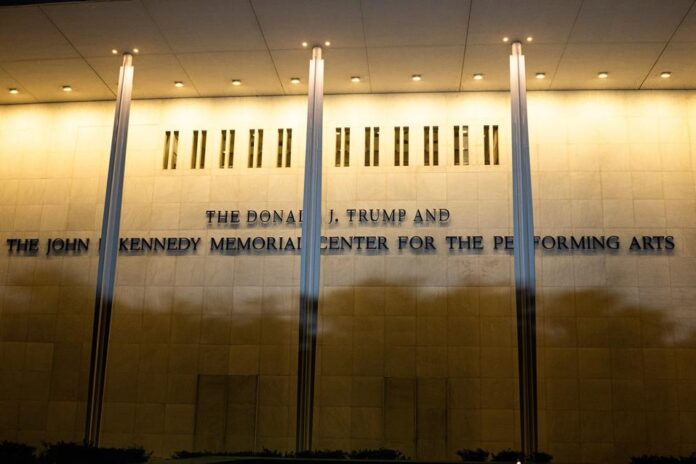
The board of trustees of the John F. Kennedy Center for the Performing Arts filed a notice of appeal late Thursday, one day before the deadline set by U.S. District Judge Christopher Cooper requiring that all references to President Donald Trump‘s name be removed from the building’s facade, website, and branding. The appeal was submitted to the U.S. Court of Appeals for the District of Columbia Circuit, marking the latest escalation in a legal dispute that has drawn national attention since the board voted in December 2025 to add Trump’s name to the historic venue.
The board — whose members were appointed by Trump and who elected him as their chairman — is simultaneously seeking a stay of Cooper’s ruling, which would pause the name-removal requirement while the appeal proceeds. Lawyers for the Kennedy Center argued in filings that requiring a name change now, only to potentially reverse it after a successful appeal, would be “incredibly confusing for the public” and would waste significant time and money should Trump’s name ultimately be restored.
The renaming itself occurred in December 2025, when the board voted to rebrand the institution as “The Donald J. Trump and John F. Kennedy Center for the Performing Arts.” Trump’s name was physically added to the building’s marble facade shortly thereafter. In May, Judge Cooper ruled that the renaming was unlawful, writing that Congress had explicitly designated the center as a memorial for President John F. Kennedy and that “only Congress can change it.” Cooper gave the center fourteen days to remove all Trump name references.
The lawsuit that triggered Cooper’s ruling was brought by Democratic Representative Joyce Beatty of Ohio, who serves on the Kennedy Center board in an ex-officio capacity through her congressional seat. Beatty argued the board acted unilaterally and in violation of the center’s founding statute, which dates to the years following Kennedy’s assassination. Her attorneys, including Norm Eisen of Democracy Defenders Action, called the renaming “a flagrant violation of the rule of law.”
By Friday morning, Trump’s name had already been removed from the Kennedy Center’s Facebook page, though the physical facade lettering remained as the appeal was filed. Trump responded to earlier developments in the case on Truth Social, threatening to disengage from the center entirely, writing that he had “no interest in continuing what could only be a hopeless journey into ‘NEVER NEVER LAND'” if he was not free to pursue his vision for the institution.
Why It Matters
The Kennedy Center dispute is not merely a fight over a name on a building. It reflects a deeper constitutional tension over what powers a president can exercise over federally chartered institutions without congressional approval. The center is technically an independent federal entity, but Congress gave it its name through statute — a fact that forms the legal cornerstone of Judge Cooper’s ruling. That distinction matters enormously for how future administrations interpret their authority over similar institutions.
For Republicans who view the renaming as a legitimate tribute to a president who championed revitalizing the center, the court order is an example of judicial overreach impeding executive authority. The Trump administration has argued throughout its second term that courts have been deployed as partisan instruments to frustrate policy initiatives ranging from immigration enforcement to foreign policy. The Kennedy Center case fits squarely within that broader White House narrative.
Democrats and cultural preservationists see the situation very differently. For them, the Kennedy Center has been a symbol of national unity and artistic excellence for more than fifty years. Attaching a sitting president’s name to it — particularly over the objection of Congress — represents an abuse of institutional power. The center’s founding as a living memorial to a slain president makes the symbolism even more charged.
The case also has direct implications for the center’s operations. Cooper’s blocked ruling would have also prevented the administration from proceeding with a two-year closure for renovations. Arts organizations, performers, and ticketholders have all been in a state of uncertainty about the center’s programming future, making a judicial resolution important not just politically but practically for one of the country’s most prominent cultural institutions.
Economic and Global Context
The Kennedy Center generates significant economic activity in Washington, D.C., drawing hundreds of thousands of visitors annually, supporting thousands of arts-sector jobs, and contributing to the tourism economy of the capital region. A two-year closure, had it proceeded, would have disrupted that activity substantially. Arts advocacy groups estimated that the closure could cost the local economy hundreds of millions of dollars in lost tourism revenue and displaced employment.
Federal funding for the Kennedy Center has historically enjoyed bipartisan support in Congress, reflecting the center’s role as a flagship American cultural institution with global visibility. The administration’s renovation plans, which the Trump board framed as necessary modernization, drew criticism from preservation and arts groups who raised concerns about the scope and timing of proposed changes.
Internationally, the Kennedy Center is one of the most recognized symbols of American soft power and cultural diplomacy. World-renowned performers and companies from every continent perform there regularly. The rebranding controversy attracted international media coverage, raising questions in allied capitals about the administration’s approach to national institutions and the rule of law.
The legal costs of the ongoing dispute — borne in part by taxpayer-supported federal entities — have not been publicly disclosed, but extended litigation through the D.C. Circuit and potentially the Supreme Court would represent a significant expenditure of legal and administrative resources.
Implications
The appeal filed Thursday sets the stage for a potentially lengthy legal battle in the D.C. Circuit, which has been the venue for numerous high-profile challenges to Trump administration actions during both his first and second terms. If the circuit court grants a stay, the name remains on the building while the appeal is heard — possibly for many months. If the stay is denied, the administration will face immediate pressure to comply with Cooper’s order.
A ruling from the D.C. Circuit would carry significant precedential weight for how courts evaluate executive authority over federally chartered cultural institutions. Other institutions — from the Smithsonian to the National Archives — are structured under similar statutory frameworks, meaning the outcome of this case could affect the legal landscape far beyond the Kennedy Center itself.
For the Trump administration, winning the appeal would validate its interpretation that presidential leadership of a federally affiliated board confers broad naming and operational authority. Losing would reinforce the principle that Congress, not the executive, holds the primary power to define the character and name of institutions it creates by statute.
For the Kennedy Center itself, the uncertainty is damaging regardless of outcome. Donors, partner organizations, and international collaborators all function better in an environment of institutional stability. Prolonged litigation keeps the center’s future in a state of legal limbo that affects planning across every dimension of its operations.
Sources

