Story Highlights
- The “Fostering the Future Accounts” will give children in foster care access to dedicated savings and investment vehicles funded with a $1,000 seed investment from the U.S. Treasury
- Accounts will open for contributions on July 4, with eligibility limited to U.S. citizen children born between January 1, 2025, and December 31, 2028
- More than 400,000 children are currently in foster care in the United States, with roughly 23,000 aging out of the system every year
What Happened
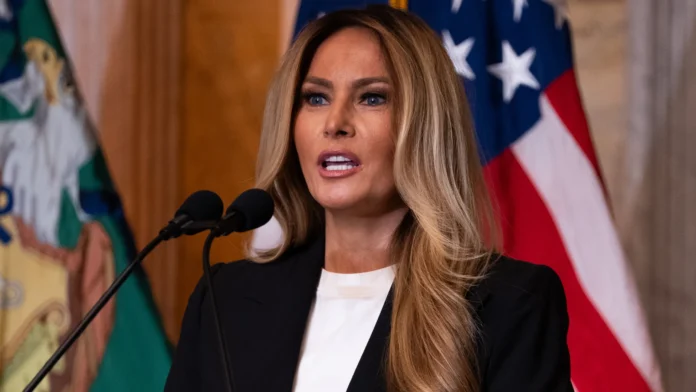
First Lady Melania Trump announced a new savings and investment account for children in foster care on Thursday, in conjunction with the U.S. Department of Treasury. The “Fostering the Future Accounts” are designed specifically for children in foster care. In her remarks, the first lady declared that for the first time, children in foster care would have access to a dedicated investment and savings vehicle.
Treasury Secretary Scott Bessent joined Melania Trump at a news conference at the Treasury Department for the announcement. The first lady said the accounts would give foster children “the same chance at asset ownership and long-term wealth as every other child.” The accounts will be open for contributions beginning July 4. To qualify, a child must be a U.S. citizen born between January 1, 2025, and December 31, 2028.
The new program is structured as a spinoff of the Trump Accounts initiative, which was created under the One Big Beautiful Bill Act and provides a $1,000 federal seed investment to eligible newborns. The Fostering the Future Accounts extend that framework specifically to children in state foster care systems, with the intention of ensuring that young people who are often left out of traditional wealth-building opportunities receive the same foundational financial start as children raised in conventional family structures.
The White House Council of Economic Advisers estimates that a Trump Account balance for a baby born in 2026 will grow to approximately $5,800 by the time the child turns 18 and reach $18,100 by age 28, assuming no additional contributions are made beyond the initial federal seed funding. The accounts track a stock index. The first lady emphasized that access to savings and investment accounts represents a first step toward personal independence for young people leaving the foster system.
Twenty-three governors have pledged to allow state agencies to begin the process of enrolling children in the program. Melania Trump called on every governor and business leader across the country to help fund these accounts. A number of states, including Georgia and Idaho, have already moved proactively to enroll eligible foster children in their care, with Georgia committing to automatic enrollment for all qualifying children born during the eligible timeframe.
Why It Matters
The foster care population in the United States is one of the most financially precarious groups of young people in the country. The program targets more than 400,000 children currently in U.S. foster care, aiming to provide them with investment and savings access for the first time. Over 23,000 young people age out of the foster system annually, highlighting the challenge these individuals face during their financial transition to adulthood. Without family support networks, savings, or established credit, young adults leaving foster care face dramatically higher rates of poverty, homelessness, and long-term financial instability than their peers.
For the Trump administration, the announcement also represents a politically important moment. At a time when the White House is managing the fallout from escalating military operations in Iran, rising inflation, and a contentious congressional fight over surveillance authority, the Fostering the Future Accounts offer an opportunity to highlight a compassionate domestic policy with broad cross-partisan appeal. Child welfare is one of the few areas where significant bipartisan goodwill still exists, and the first lady’s visible role in championing the initiative gives it a profile that extends beyond traditional policy audiences.
Melania Trump has consistently focused on foster care and child welfare as her signature policy portfolio since returning to the White House. Advisers describe the Fostering the Future Accounts as her idea — a program she personally architected and championed through the legislative process that produced the One Big Beautiful Bill Act. The hands-on ownership she has taken of this initiative distinguishes it from many first-lady-affiliated causes that are nominally associated with the office without substantive policy involvement.
The broader significance of the program lies in its potential to shift the long-term economic trajectory of a population that has historically been overlooked by wealth-building policy. By giving foster children access to compound investment growth from birth — or from entry into the foster system during the eligibility window — the program creates a financial foundation that could meaningfully reduce the economic hardship that so many foster system alumni experience in adulthood.
Economic and Global Context
The Fostering the Future Accounts are structured around the same investment framework as the broader Trump Accounts initiative, which represents one of the more ambitious wealth democratization efforts in recent American policy history. By connecting every eligible child — including those in state custody — to a stock market index fund from the earliest years of life, the program attempts to address one of the most persistent structural inequities in American economic life: the gap between those who inherit financial assets and those who do not.
The projected growth figures from the White House Council of Economic Advisers are based on historical stock market performance assumptions. Critics of the initiative have noted that projected returns are contingent on market conditions and that families with the lowest incomes — including foster parents and state agencies — may not be in a position to make additional contributions beyond the federal seed funding. Supporters counter that even the base $1,000 investment, compounded over 18 or 28 years, represents a meaningful financial resource for a population that currently leaves state care with virtually no assets at all.
State participation levels will determine the program’s ultimate reach. Georgia has become one of the first states to ensure that eligible foster children can benefit from the Trump Accounts, automatically enrolling all qualifying children in the state system to receive the seed funding. Idaho Governor Brad Little also attended Thursday’s Treasury Department event, highlighting his state’s early commitment to the program. The first lady’s appeal to business leaders to contribute to individual accounts suggests a future role for private sector philanthropy in scaling the initiative beyond its federal funding base.
Treasury infrastructure for the accounts is already largely in place given the parallel rollout of the broader Trump Accounts program. The administrative burden on states will be to identify eligible children within their foster care systems and complete the enrollment process before July 4 account opening, a timeline some state agencies have described as ambitious but achievable with adequate coordination.
Implications
With 23 governors on board at launch, the Fostering the Future Accounts have the potential to reach hundreds of thousands of children in their first years of implementation. The program’s success will ultimately be measured not by enrollment figures but by whether the financial resources it creates actually translate into improved long-term outcomes for the young adults who receive them. That data will take years to accumulate, but the program design reflects serious engagement with the evidence base on asset-building and economic mobility.
For the Republican Party, the initiative offers a template for compassionate conservatism at a moment when the party’s brand is heavily defined by military policy and immigration enforcement. Child welfare programs with tangible, measurable benefits represent a vehicle for broadening the GOP’s policy appeal without departing from its core economic philosophy of individual ownership and market-based solutions.
State governments that opt in will face implementation choices about outreach, enrollment procedures, and whether to supplement the federal seed funding with state contributions. Those decisions will shape the equity of the program’s reach within each state, particularly for children in rural areas or low-capacity county-run foster systems where enrollment processes may be less efficient.
The Fostering the Future Accounts also set a precedent for future expansions of the Trump Accounts framework to other underserved populations. If the foster care initiative demonstrates measurable take-up and political staying power, it could open the door to analogous programs for other children who lack access to traditional family wealth-building structures.
Sources
“Melania Trump announces a new savings account for youth in foster care”

