
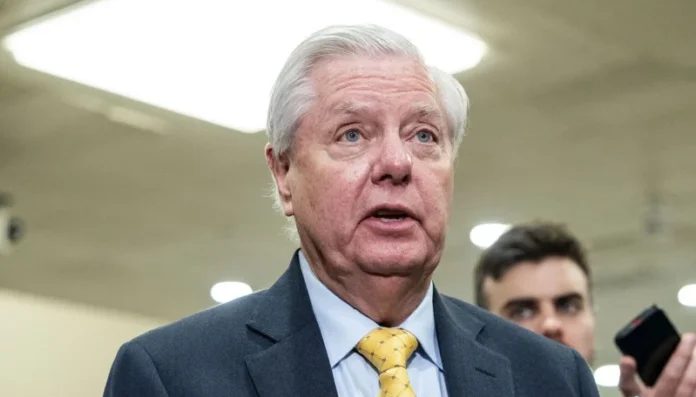
President Trump has thrown his support behind a long-stalled bipartisan bill imposing steep secondary tariffs on countries that continue buying Russian oil, with senators now pushing for quick passage in honor of the late Sen. Lindsey Graham. The legislation would hand Trump sweeping new authority to punish China, India and other major buyers of Russian energy, marking one of the most consequential shifts yet in Washington’s approach to pressuring Moscow over its war in Ukraine. Graham’s sudden death over the weekend has added new urgency and emotional weight to a measure he championed for more than a year.
Story Highlights
- A bipartisan coalition of senators reached agreement with the White House on the Sanctioning Russia Act after more than a year of delay
- The bill would authorize steep secondary tariffs on countries such as China and India that continue purchasing Russian oil and gas
- Democrats and Republicans are calling for swift passage as a tribute to Graham, who negotiated the deal shortly before his death
What Happened
Sen. Lindsey Graham traveled to Kyiv last week to brief Ukrainian President Volodymyr Zelenskyy on a breakthrough he had helped negotiate with the White House: a bipartisan agreement to move forward on the Sanctioning Russia Act, legislation first introduced in 2025 that would give President Trump authority to impose steep secondary tariffs on countries continuing to purchase Russian oil, natural gas and uranium. Speaking to reporters in the Ukrainian capital, Graham said the Senate had reached an agreement with the White House “about 30 minutes ago,” calling it a formula that could finally help bring the war to an end.
The original version of the bill, drafted by Graham and Sen. Richard Blumenthal, proposed tariffs of up to 500 percent on imports from any country doing business with Russia’s energy sector, along with a similar tariff on remaining Russian imports into the United States. The legislation drew 85 co-sponsors, comfortably clearing the 60-vote threshold needed to overcome a filibuster and approaching the two-thirds majority required to override a presidential veto. A companion measure, introduced by Reps. Brian Fitzpatrick and Mike Quigley, has also been advancing in the House.
The bill had stalled for more than a year, first over Democratic concerns about handing the president broad tariff authority while a related Supreme Court case was pending, and later because Senate Majority Leader John Thune held it back to give Trump room to negotiate directly with Moscow. Trump had repeatedly wavered between claiming progress with Russian President Vladimir Putin and expressing frustration over the Kremlin’s refusal to halt its offensive. According to senators involved in the talks, three factors ultimately pushed the White House toward supporting the measure: recent Ukrainian battlefield gains, a softening in global oil prices that reduces the economic shock of cutting off Russian supply, and continued Russian strikes on Ukrainian civilians.
Graham’s death from an aortic dissection over the weekend, just days after securing the agreement, has transformed the bill’s path forward into something of a legislative tribute. Senators from both parties have urged colleagues to bring the measure to the floor quickly, framing swift passage as a fitting honor for a lawmaker who spent more than a year pushing the legislation. Vladyslav Vlasiuk, a Ukrainian sanctions official, said Russia earned roughly 58 billion dollars from oil exports to China and India in just the first half of this year, underscoring the scale of revenue the bill aims to disrupt.
Why It Matters
For Republicans, the bill represents a rare instance of the party uniting behind an aggressive economic weapon against Russia at a moment when the administration has otherwise sought to balance pressure on Moscow with efforts to negotiate a peace settlement. Passing it would give Trump one of the most sweeping secondary tariff authorities Congress has ever explicitly granted a president over third-country trade relationships, a significant expansion of executive power that Republicans have generally supported when wielded by their own party.
The legislation also carries direct implications for American consumers and businesses, since secondary tariffs of the scale proposed could disrupt global energy and trade flows well beyond Russia itself. If China, India or other major economies refuse to curtail Russian oil purchases and instead absorb the tariff, the resulting trade friction could ripple into supply chains and pricing for goods far removed from the energy sector.
Graham’s death adds a layer of political momentum that may be difficult for Senate leadership to resist, even among members who previously had reservations about the bill’s tariff provisions. Some Republicans, including Sen. Rand Paul, have publicly opposed the bill on grounds that it would damage broader American trade relationships, a tension that is likely to resurface even as colleagues rally around Graham’s legacy.
For Ukraine, the bill’s advancement signals that Washington’s appetite for economic pressure on Moscow has not diminished despite ongoing peace negotiations. Ukrainian officials have consistently argued that Russia’s energy revenue is one of the primary pillars sustaining its war effort, making the bill’s passage a top diplomatic priority for Kyiv.
Economic and Global Context
Russia’s seaborne oil exports total roughly 3.2 million barrels per day, with China and India serving as its largest customers since Western nations curtailed purchases following the 2022 invasion. Should the bill pass and its tariff triggers be enforced, global energy markets would face an immediate test of whether those two countries could realistically redirect such volumes to other suppliers, or whether the threat of steep tariffs would be enough to produce voluntary compliance without ever triggering the penalties.
Financial analysts and former Treasury officials have described the use of tariffs as a sanctions tool as largely untested, raising questions about whether targeted countries might simply call Washington’s bluff and continue importing discounted Russian crude, particularly given the economic costs the U.S. would also bear amid ongoing trade negotiations with Beijing. The bill’s fate is further complicated by uncertainty over its final tariff rate, as reports suggest the White House-negotiated version may include revised figures lower than the original 500 percent proposal.
Globally, the legislation lands amid broader efforts by the administration to reshape trade relationships through tariff policy, including separate measures affecting semiconductors, autos and other goods. A new wave of secondary tariffs tied to Russian energy would add another significant variable for multinational companies and foreign governments already navigating a shifting American trade posture.
Implications
In the near term, the Senate is expected to move toward a floor vote, with Thune signaling he hopes to act before the chamber’s August recess, though he has not committed to a firm date. The bill’s broad bipartisan co-sponsorship suggests it has the votes to pass if brought to the floor, but the exact tariff rate and enforcement mechanisms remain subject to further negotiation with the White House.
For China and India, passage of the bill would force a consequential decision: absorb steep tariffs, cut back on Russian energy imports, or seek alternative arrangements that could reshape global oil trade patterns. Businesses with exposure to those markets will be watching closely for signs of how aggressively the administration intends to enforce the new authority.
For Senate Republicans, the coming weeks will test whether Graham’s death accelerates a bill that had languished for over a year, or whether internal GOP divisions over tariff authority and trade policy resurface once the emotional momentum of his passing fades. Either outcome will shape how forcefully Washington signals its resolve to Moscow as peace negotiations continue.
Source
Bipartisan senators welcome deal with Donald Trump on stalled Russia sanctions bill

