Story Highlights
- Trump said the two sides are in the “final throes” of a deal that would prohibit Iran from ever possessing nuclear weapons
- The conflict exceeded 100 days on Sunday, far longer than Trump’s initial projections
- A top Iranian official told CNN that Tehran sees no “serious will” from Washington to finalize a framework
What Happened
President Donald Trump repeated his claim that a deal to end the war in Iran could be reached in “two or three days,” and that the critical Strait of Hormuz would reopen “immediately” after such an agreement. Speaking to reporters after attending Game 3 of the NBA Finals in New York, Trump described the ongoing negotiations in optimistic terms, saying the two parties are in the final stages of a deal that would bar Iran from developing nuclear weapons.
Trump has previously promised an imminent resolution to the conflict, only for hostilities to resume later. He initially said fighting would last four to six weeks, but the conflict crossed the 100-day mark on Sunday. Despite that history, administration officials remained publicly confident, with the White House attributing Iran’s desire to negotiate to the success of what it called Operation Epic Fury, Operation Economic Fury, and the naval blockade of Iranian waters.
Trump claimed that the U.S. naval blockade on Iran had “turned out to be much stronger than bombing” in pushing Iran toward a settlement. He added the U.S. could “very easily” spend another two or three weeks bombing, leaving Iran with nothing, but that would delay the reopening of the strait.
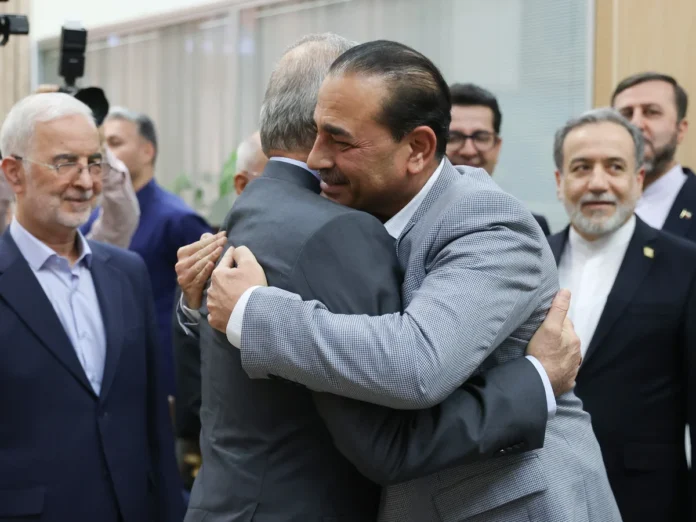
Benjamin Netanyahu said Israel had halted attacks on Iran, stopping short of acknowledging a formal ceasefire that Trump said both countries were aiming for. Iran also suspended its operations against Israel but warned it would resume them if Israeli strikes in southern Lebanon continued. Separately, a top Iranian official told CNN that Tehran has no objection to pushing forward with peace talks, provided the U.S. side demonstrates genuine honesty and sincerity in the process.
Sky News Arabia reported Monday that a draft agreement had been sent to the U.S. for review and that it is “preliminarily acceptable” to the White House. However, Iran’s state-affiliated Fars news agency disputed Trump’s characterization of the deal, reporting that the Strait of Hormuz would remain under Iranian control under the latest version of the proposal.
Why It Matters
The Iran conflict has emerged as the defining foreign policy challenge of Trump’s second term. A deal — if it holds — would represent a sweeping diplomatic achievement, ending a war that began with joint U.S.-Israeli strikes on Iranian nuclear facilities and escalated into a prolonged military campaign involving a naval blockade. For American voters, particularly those who backed Trump on an “America First” platform, the cost of the war in blood, treasure, and disrupted trade has been a mounting concern.
The Strait of Hormuz is one of the world’s most critical chokepoints, carrying an estimated 20 percent of globally traded oil. Its continued closure has contributed to elevated energy prices, supply chain disruptions, and economic uncertainty across the United States and allied nations. A swift resolution and immediate reopening, as Trump has promised, would provide immediate relief to commodity markets and households already strained by high fuel costs.
The credibility of Trump’s optimistic timeline is now itself a political variable. Having repeatedly forecast imminent deals only for fighting to resume, the administration faces pressure to produce a verifiable, durable agreement rather than another temporary pause. Congressional Republicans — particularly those with hawkish foreign policy views — are watching closely to ensure any deal does not leave Iran with a path to nuclear weapons or the ability to reconstitute its regional proxies.
The broader implications for the Middle East are substantial. An agreement would also need to address Lebanon, where Israel renewed its military assault, striking the southern city of Tyre and issuing an evacuation warning that for the first time included the port’s Christian quarter. Any lasting deal must account for Israeli security concerns in Lebanon, which remain unresolved.
Economic and Global Context
The Strait of Hormuz closure has reshaped global energy markets since the war’s escalation. Oil tanker traffic through the strait, which connects the Persian Gulf to the Gulf of Oman, has been suspended or severely restricted, forcing crude oil to take longer and more expensive routes. Analysts estimate that extended closure has added between $10 and $20 per barrel to global oil prices, a burden passed directly to American consumers at the gas pump.
Allied nations, particularly in Europe and Asia, have grown increasingly anxious about the economic fallout. Japan and South Korea, two of the world’s largest importers of Persian Gulf crude, have been particularly exposed. European nations dependent on liquefied natural gas transiting through the region have also faced supply uncertainty. The longer the closure continues, the more lasting the damage to global trade networks and energy investment patterns.
U.S. defense spending associated with the conflict — including the naval blockade, air campaigns, and logistics — has also added to federal expenditure at a time when Congress is already battling over discretionary spending caps. Any deal that reopens the strait would ease these fiscal pressures, though the costs already incurred represent a significant addition to the national debt.
Implications
If a deal is reached in the coming days as Trump predicts, the immediate economic response would likely be positive. Energy markets would welcome the reopening of the Strait of Hormuz, and a de-escalation of U.S. military activity in the region could reduce the risk premium currently embedded in oil prices. American businesses with global supply chains would also benefit from restored shipping routes.
For Republicans heading into the 2026 midterms, a declared end to the Iran war would give the party a major talking point. Trump could credibly claim a historic foreign policy achievement — ending a war, securing a nuclear agreement, and restoring a vital shipping corridor — on a compressed timeline. That narrative would be particularly powerful in states with high military family populations.
The political risk runs in the other direction if the deal collapses. Iranian officials and Netanyahu have offered conflicting signals about whether a true ceasefire is even in effect, let alone a final agreement. If hostilities resume again after another round of presidential optimism, the credibility damage to Trump’s foreign policy brand would be significant, and Democrats would have a potent line of attack heading into November.
For American allies in the region, particularly Saudi Arabia and the UAE, any agreement will be scrutinized carefully to determine whether it adequately constrains Iran’s conventional military capabilities and support for regional proxy forces. A deal perceived as too lenient could push Gulf states toward independent security arrangements that reduce American influence.
Sources
“Trump repeats claims that Iran deal is only ‘days’ away, despite recent strikes”

