Story Highlights
- The CPI rose 4.2 percent year-on-year in May 2026, the third consecutive monthly increase and the first time inflation has topped 4 percent since 2023
- Trump said inflation would drop “like a rock” once the Iran war ends, framing elevated prices as a temporary wartime byproduct
- Senate Democrats, including Minority Leader Chuck Schumer, immediately used the clip to argue Trump is indifferent to the financial struggles of American families
What Happened
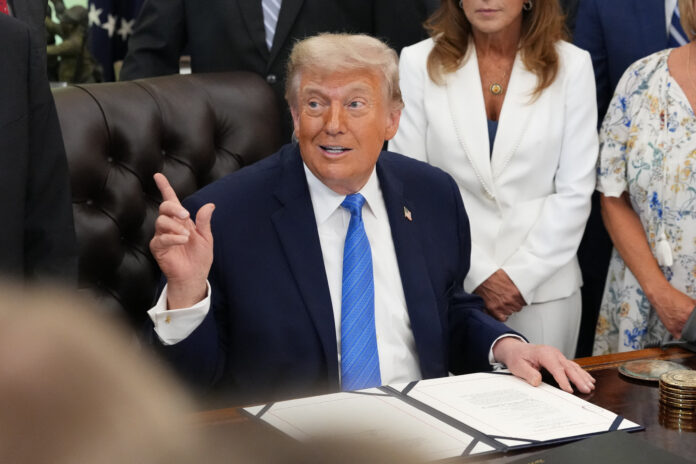
Donald Trump embraced an unlikely position Wednesday, telling reporters he welcomed the latest inflation data. Asked whether he was concerned about newly released figures showing the annual inflation rate surging to its highest level since early 2023, Trump praised the government numbers directly. “The numbers were great,” he said, adding a line that instantly went viral across social media platforms.
Trump’s remarks came as he was responding to data from the Bureau of Labor Statistics showing the Consumer Price Index rising at a faster rate in May for the third consecutive month, with the 4.2 percent increase from May of last year representing the first time inflation had topped 4 percent since 2023. The president appeared unusually optimistic about a metric he spent years hammering Democrats for allowing to run out of control during the Biden administration.
Trump predicted that inflation would “come down like a rock” once the United States’ war with Iran is over, linking the current price surge explicitly to wartime conditions and referencing American efforts to route oil shipments through the Strait of Hormuz. He later told reporters that what he meant to say was that despite being in a war, the numbers had come in lower than anticipated — an attempt to walk back the original framing that generated significant backlash within hours.
House Speaker Mike Johnson later argued that the president’s remarks had been taken out of context. Senate Democratic Minority Leader Chuck Schumer countered that the comments demonstrated Trump’s disdain for the financial struggles faced by American families. Senator Elizabeth Warren also publicly condemned the remarks, accusing the president of failing to take the cost-of-living crisis seriously.
Trump’s comments on inflation came as fellow Republicans expressed concern that consumer angst over rising prices could cost GOP lawmakers their slim majorities in both chambers of Congress when November elections arrive. Trump had previously raised eyebrows in May when he told reporters he did not think about Americans’ financial situation, framing his focus on the Iran war as the overriding priority.
Why It Matters
Inflation is arguably the single most politically potent economic variable for American households, and the trajectory of prices heading into the November midterms will shape the electoral landscape in ways that few other issues can match. Trump built much of his 2024 campaign on the promise of delivering lower costs after the Biden-era inflation surge. His Wednesday comments — captured on camera, in the Oval Office, with reporters present — give Democrats a ready-made counter-narrative.
The 4.2 percent annual rate is not, in isolation, a catastrophic figure by historical standards. But in the context of Trump’s own stated benchmarks and the political promises he made to working-class voters, it represents a significant credibility gap. Energy prices, which drove the bulk of the increase, are directly tied to a military conflict that Trump chose to initiate and has thus far declined to conclude through a negotiated settlement.
For Republican congressional candidates in competitive districts, the combination of a wartime economy, elevated gas prices, and a president joking about loving inflation creates a difficult messaging environment. Down-ballot Republicans will need to either defend the president’s framing or carefully distance themselves without undermining the administration — a difficult balance in a party where loyalty to Trump remains an essential political currency.
The episode also underscores a deeper tension within the administration’s economic communication strategy. Treasury Secretary Scott Bessent and White House economic advisers have consistently argued that core inflation — which excludes food and energy — remains relatively contained. But the headline number that consumers experience at the gas pump and grocery store is what shapes voter sentiment, and the 4.2 percent figure is the number that will appear on campaign mailers this fall.
Economic and Global Context
The consumer price index rose 4.2 percent in the twelve months through May, the largest gain since April 2023. The index had risen 3.8 percent year-on-year in April and 3.3 percent in March. Monthly, prices increased 0.5 percent in May, following a 0.6 percent gain in April. The trend line is clearly accelerating, not moderating.
Energy costs are largely responsible for the rising index, accounting for more than 60 percent of the increase in all items. Energy prices rose 3.9 percent in May, following a 10.9 percent surge in March and a 3.8 percent gain in April. Core inflation, excluding food and energy, came in at 2.9 percent year-on-year in May. That core figure, while elevated above the Federal Reserve’s 2 percent target, is broadly in line with economist forecasts and suggests that war-driven energy costs have not yet fully spread into broader categories of goods and services.
Economists are warning that energy price spillovers into other categories are a real risk if relief does not materialize soon. “If we don’t see a moderation in energy prices soon, it will only be a matter of time before we see more visible spillovers into other goods and services categories and into inflation expectations,” said Scott Anderson, chief U.S. economist at BMO Capital Markets, adding that the potential for future interest rate increases remains very much on the table.
The Federal Reserve faces a genuinely difficult policy dilemma. New Fed Chair Kevin Warsh, nominated by Trump, is under political pressure from the president to reduce interest rates even as incoming data argues for the opposite course. Rate hikes in a wartime economy carry their own risks, including higher borrowing costs for businesses and households already strained by elevated prices.
Implications
The political fallout from Trump’s “I love the inflation” remark is likely to persist for weeks. Democratic campaign committees have already circulated the video clip widely, and it will almost certainly appear in television advertisements targeting swing-district Republicans in the fall. The challenge for the White House communications team is that the clip is unambiguous and self-contained — it does not require editing or additional context to be damaging.
For the Federal Reserve, the May CPI data reinforces the case for caution about cutting rates prematurely. If the Iran conflict drags on and energy prices remain elevated, the Fed may find itself in the uncomfortable position of needing to raise rates at a time when the president is publicly demanding cuts. That dynamic could create institutional tension between the White House and the central bank at a particularly sensitive moment.
Consumers and businesses will be watching the June data release closely. If the Strait of Hormuz remains closed and fuel costs continue climbing, the trajectory toward a 5 percent annual rate is plausible within months. At that level, the political damage to Republicans heading into midterms would become substantially harder to contain — regardless of how the president characterizes the numbers from the Oval Office.
Sources
“Trump says ‘I love the inflation’ as annual rate hits 3-year high”

